Manufacturing solutions for turbine housings
In the aviation and energy sectors, turbine manufacturing companies rely on Starrag machines because they are among the most powerful and precise solutions the market has to offer. This applies not only to the manufacture of engine blades and blisks, but also to turbine housings. Decades of experience have gone into the wide range of Starrag machine tools to offer solutions for the entire manufacturing process.
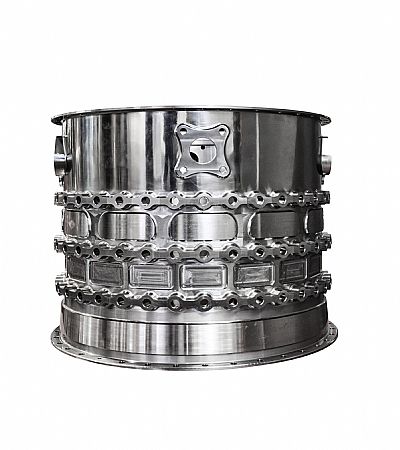
The housings and casings for aircraft engines, steam, and gas turbines are available in small and large sizes. They are becoming ever more complex and are increasingly made from materials that are difficult to machine. This usually requires several processing technologies, ideally combined in one machine or in flexible manufacturing systems. Thanks to its wide range of machines, Starrag can meet all requirements.
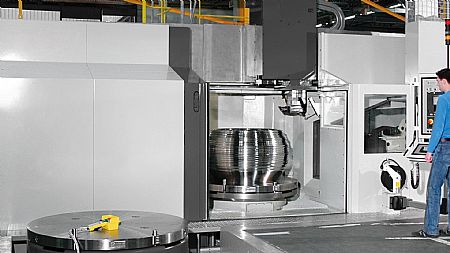
The Starrag STC series covers a large area of turbine casing machining, with its various sizes and designs capable of handling casing diameters up to 3.3m. The machines are predestined for economical 5-axis heavy-duty machining of sophisticated casings made of titanium and Inconel.
For machining smaller casings, Starrag can offer the Heckert X series in MT design. They allow high-precision turning and milling on one machine. The 5-axis X variants of this compact series add another option: The positioning axis in the rotary swivelling table is ideal for angled holes, as are often required in casings.
Suppose the huge steam and gas turbine housings with diameters of up to 12m need to be machined. In that case, Starrag can rely on correspondingly large Droop+Rein portal machining centres, which are built at Starrag Technology GmbH in Bielefeld. The large vertical Dörries lathes, which are also used for steam and gas turbine housings, are also produced there. Vertical turning and grinding is also the speciality of the Berthiez machines from the Starrag plant in St. Etienne, France, which are mainly used in aircraft construction.
For ultra-precision machining on casings, for fine boring and milling as well as precision grinding, Starrag has the SIP horizontal or vertical jig boring machines, which are produced in Vuadens in Switzerland.
The Bumotec CNC turning/milling centres, which produce small, high-precision, and complex parts in five axes and with accuracies of just a few micrometres, also come from this plant. In the production process of casings, they are used for components to be mounted, such as injection nozzles.
The UK subsidiary TTL, which handles maintenance, repair, and overhaul (MRO) tasks, plays a vital role in the turbine housing sector. Specialising in Siemens NX CAM, a tool commonly used in the turbine industry, and as a process developer for adaptive milling, TTL is the ideal partner for maintenance and repair of casings. After build-up welding and precise milling, the costly housings are restored to almost new condition.
Alexander Fitz, Sales Director for Aerospace & Turbine at Starrag AG, explains: “Machine tools are one of our core competencies, which no other company in the world can offer in terms of their technological breadth and varying sizes. We also have an in-depth technical understanding of the entire process chain required to manufacture ready-to-install turbine housings.”
This expertise enables Starrag to combine various machining operations in one machine. Klaus Struebel is Segment Sales Manager Aerospace & Turbines at Starrag with decades of expertise in the field of turbines. He points out that the integration of milling, turning, and grinding with self-developed angle and other machining heads can reduce clamping positions and increase productivity. “If one machine is not sufficient for machining, we can combine our different product ranges in flexible manufacturing systems, for example a Starrag STC with a Berthiez vertical turning-grinding centre,” says Struebel. “Standardised interfaces and pallets allow us to speed up the process and increase accuracy. If required, we integrate additional washing, drying, and measuring processes.”
Gaining a market advantage from tools adapted to the process
Starrag in Rorschacherberg has been developing and grinding carbide milling cutters for aircraft and turbine components made of difficult-to-cut materials such as titanium, Inconel, or high-alloy steels for many years. In most cases, these are customised products that are adapted to the respective machining process, i.e. to the component, the machine, the material and other concomitant circumstances. They ensure faster machining and have a longer service life than standard tools – an important contribution to a stable, repeatable process.
Machining expert Struebel cites the required bores: “Especially the internal ones, these are a major challenge in housing machining. We develop special interchangeable angle heads for this purpose, and these also have to be able to cope with the limited space available.” This requires a great deal of experience – as does deep-hole drilling with very small diameters in titanium or Inconel. Tight tolerances must be maintained for the drill holes so that add-on parts – such as blades – can be fitted precisely.
Another of Starrag’s strengths is the gear spindle manufactured in Rorschacherberg, which remains thermally and mechanically stable and is highly durable even when processes are running for 80 hours. It is used on STC machining centres and Droop+Rein gantry machines. For the latter, different special heads are available, including angle heads in various lengths, with different torques and speeds.
Klaus Struebel summarises: “We provide our customers with higher productivity by looking at the entire process. We don’t just sell a product, we make sure that the machine fits the machining application in terms of size, technology, axis configuration and kinematics, and then optimise the process with the appropriate peripherals.”
This usually takes place at the ATCC (Aerospace Turbine Competence Center) in Rorschacherberg, which offers the best conditions for this. Covering an area of around 2,000m2, it is equipped with the latest 4- and 5-axis Starrag machining centres. Developers and application specialists are also on call. The ATCC is also able to produce test and small series runs for customers.